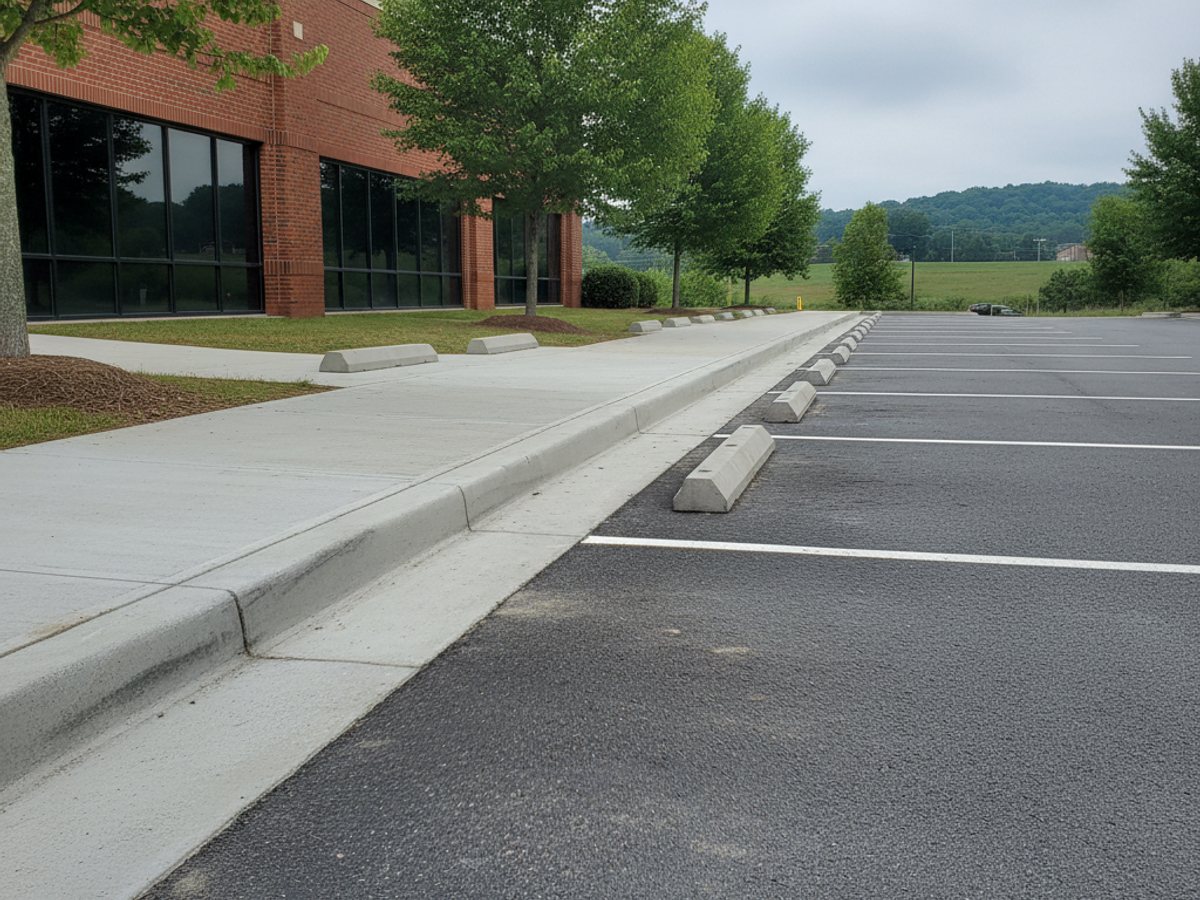
Concrete looks simple from the sidewalk. Gray mud, a truck, some guys with trowels. What you can't see is the part that decides whether your driveway lasts 25 years or cracks apart in five, and that part happens before the first yard of concrete ever hits the ground. If you're getting quotes in Glade Hill or anywhere around Franklin County, here's what actually separates a contractor worth your money from one you should let walk.
Know what's under your yard first
Franklin County ground is mostly red clay over rock, and how deep you hit rock changes street to street. Clay holds water and swells when it's wet, then shrinks and pulls away when it dries out in August. A slab poured on top of clay with no gravel base underneath will move with that clay, and it'll crack along the same lines the ground is already stressed at. Properties closer to Smith Mountain Lake sometimes sit higher on the water table too, especially after a wet spring, which matters for anything going in below grade like a retaining wall footing or a walkout slab.
A contractor who's worked this county should be able to tell you, before they ever quote you a price, whether they expect to hit rock on your lot and what they'll do if they do. If they haven't asked about your soil or looked at your yard beyond snapping a photo for the estimate, that's worth noticing.
Ask how they're handling the base, not just the pour
The gravel base under a slab usually runs 4 to 6 inches of compacted crushed stone, more if the native soil is soft or if it's clay-heavy like most of what you'll find around here. That base does two jobs: it gives the slab something stable to sit on, and it lets water drain out from under the concrete instead of sitting there and freezing. Skip the compaction step, or use too thin a base, and you get settling. Settling shows up as a dip, a crack, or a slab that's pulled away from the garage floor by six months in.
Ask directly: how many inches of base, what's it compacted with, and do they test the compaction or just eyeball it. A contractor who's done this a while will answer without blinking. One who hasn't will change the subject to the finish and the color options, because that's the part that's easy to sell.
Rebar, wire mesh, and slab thickness
For a standard driveway you're looking at a 4-inch slab as a minimum, thicker if it'll see truck or trailer traffic. Reinforcement is where contractors cut corners without you ever knowing, because once the concrete's poured you can't see what's inside it. Wire mesh is cheaper and it's fine for a patio or a walkway with light foot traffic. For a driveway, rebar set on chairs so it sits in the middle of the slab, not resting on the gravel, holds up better over time and handles the freeze-thaw cycling we get here from December through March a lot better than mesh that's been stepped down into the mud during the pour.
The concrete mix matters too. A 3,500 to 4,000 PSI mix with air entrainment is standard for exterior work in this part of Virginia, because the air bubbles give the water somewhere to expand into when it freezes instead of blowing the surface apart. If a quote doesn't mention PSI or air content at all, ask. If they can't tell you, that's a real gap, not a small one.
Joints, cure time, and what rushing costs you
Concrete cracks. That's not a defect, that's physics, it shrinks as it cures and it has to crack somewhere. The whole point of control joints is to tell the slab where to crack instead of letting it pick its own spot down the middle of your walkway. Those joints should be cut within 24 to 48 hours of the pour, spaced roughly every 8 to 10 feet on a driveway, and cut to about a quarter of the slab's depth. A contractor who pours a driveway and doesn't come back to cut joints, or waits four or five days to do it, is skipping a step that costs them very little time and saves you a random crack later.
Cure time is the other place people get impatient. You can usually walk on a new slab after a day or two, but it needs 5 to 7 days before you drive a car on it, and it isn't at full strength until around 28 days. Hot, humid Virginia summers speed up the surface cure and can make it look ready before it actually is underneath, which is exactly when people back a loaded truck onto a driveway too soon and leave tire marks pressed into the surface forever.
Permits and how it works around here
Franklin County handles building permits for this kind of work, and depending on where your property sits and what you're building, a driveway addition or a retaining wall over a certain height can trigger a setback check or a permit review, especially if you're near a property line or a right-of-way. A lot of Glade Hill and the surrounding rural stretches of the county don't have an HOA to deal with, but some of the newer developments closer to Smith Mountain Lake do, and those can have their own rules on driveway width, materials, or even color. A contractor who's pulled permits in this county before will know roughly what's expected and won't leave that step to you to figure out after the fact.
Older properties around here, especially farmhouses and homes built before the lake developments went in, often have septic lines, old wells, or buried utility runs that were never mapped well. Call 811 before anyone digs, and ask your contractor if that's already part of their process or something you need to arrange yourself.
What tells you to walk away
Some of this comes down to plain instinct, but there are patterns worth naming. A large cash deposit before any work starts, with no contract in writing, is a bad sign no matter how friendly the person is. So is pressure to sign the same day the estimate comes in. A written quote should spell out the slab thickness, the PSI of the mix, the base depth, and whether it's rebar or mesh, not just a total price and a start date. If a contractor can't answer a direct question about any of that, or gets vague and steers you back to talking about finishes, take the hint.
Ask for proof of general liability insurance and confirm they're licensed to do this work in Virginia. Ask how they handle a slab that cracks in the first year, because reputable contractors will tell you plainly, not dodge it. Concrete work outdoors in this climate is never going to be crack-proof, and anyone who promises that isn't being straight with you.
If you're comparing quotes for a driveway, patio, or retaining wall in Glade Hill and want someone to walk your lot and talk through the actual ground conditions before quoting a number, that's the conversation worth having before anything gets scheduled. You can see the range of our concrete contractor work and go from there.